


A Nightmare on Elm Street
Crime / Horror
91 min.
1984
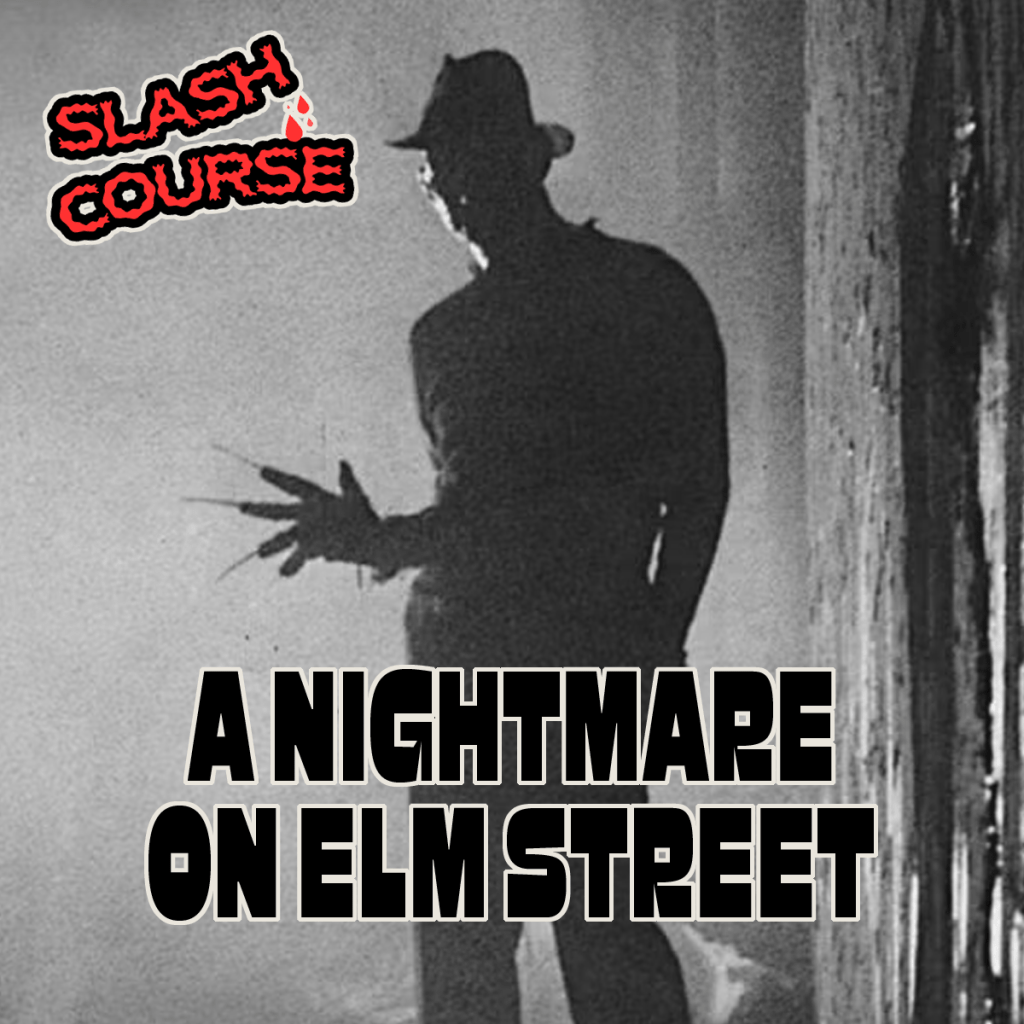
One, Two, Freddy’s coming for you. Three, four, better lock your door. The Nightmare on Elm Street, directed by Wes Craven, has become a staple in the slasher genre and marks the end of the golden age of slashers we’ve explore so far. Not for the faint of heart, Elm Street features ample practical effect with gallons of blood spilled across the movie’s hour and a half runtime. Freddy Kreuger also presents a new killer archetype to the genre, his quips and taunting of his victims prior to killing them contrasts the looming figure of Michael Myers or the near-invisible Ms. Voorheers.
With clawed fingers, a stripped sweater, jaunty fedora, and burn scars, Freddy has a striking image. An image that does not hide behind a mask like prior threats we’ve seen. Lurking in the dreams of his victims, his existence in the dream realm makes the task of convincing those closest to our final girl seemingly impossible. However, as Nancy Thompson tries to explain this threat to those around here we can sense something isn’t quite right. The adults around her seemingly aware of this killer, or at least a Fred Kreuger who matches his description.
If you were expecting a slasher with violence comparable to our past installments in Slash Course, sorry. An early example of extensive practical effects becoming a horror movie staple, Craven pushed boundaries with what was thought possible for the slasher genre. In part, this can be attributed to his decision to enter into the fantastical with a dream-killer — his battleground being free from the limits of the physical world.
A Nightmare on Elm Street, along with our other Slash Course entries so far, became three of the largest franchises of the next era of horror. With much of horror moving towards direct-to-VHS as the golden age of the slasher faded out. These three films end up having considerable influence over one another throughout their franchise runs, Elm Street in particular opening the door for the more supernatural themes of later installments in Halloween and Friday the 13th.
(I had a joke about Freddy Kreug-Car written about the final scene of the movie, but couldn’t fit it in anywhere, so enjoy the bad pun on its own.)
Discussing Slash Course
Welcome to our mid-series discussion for Slash Course! We will be exploring some concepts that unify the movies we’ve seen so for and should help inform our discussions about the next half of the film club. Today, we will be going over the history of the slasher genre, from the first film attributed to the sub-genre to the social conditions that lead to an interest in these violent stories.
The First Slasher
We didn’t discuss Alfred Hitchcock’s Psycho (1960), but its role as the first slasher laid the groundwork for the tropes we see repeated throughout our film club. The killer as a character within the world with backstory and motivation, a location the killer has personal ties to, and the safety of day versus the tension of night, all originate from Norman and the Bates Motel.
Psycho used mystery throughout the film to develop broad tension, but the rise of the golden age saw this stripped back as the killer poses the sole threat to our given cast of characters.
The Origins of Slashers
So far, we’ve had the opportunity to watch Halloween (1978), Friday the 13th (1980), and A Nightmare on Elm Street (1984). These three movies are the most widely known films released during the golden age of slashers, each incrementally growing in their depictions of violence. Horror is often seen as a reflection of society and culture, slashers being just another example of this.
Prior to the rise of slasher films, American horror had a fascination with the inhumane threat — think Frankenstein, King Kong, the Creature from the Black Lagoon. These creatures often developed through the hubris of man, a reflection of the constant destruction mankind had engaged in throughout events, like World War 1. These creature features preying on fears of this destruction coming home to roost.
Following the Vietnam War, Americans had became accustomed to witnessing man-made violence on their television screens. Released in the proceeding years, the golden age of slasher became early examples of human aggressors in American cinema. Many early directors in the genre took inspiration from European film movements like the Italian Giallo horror and the German Krimi films.

This transition from creature to killer reflected a public shift in understanding violence and the capacity for humans to cause harm.
A Killer Personality
There are two major camps that slasher killers fall into, the non-verbal and the boisterous. Early examples of the former are Michael Myers and Jason Voorhees, often over-sized and physically imposing these killers rarely speak only offering a looming threat for us to gawk at. The other group, the boisterous, is my personal favourite. So far we’ve only gotten to see Freddy exemplify this group in our film club, but examples like Candyman, Chucky, and, more recently, M3GAN also come to mind when thinking about memorable killers.
The personality-driven killer often makes for a less imposing image, but definitely one that is more memorable. The mocking quips of Freddy before his inevitable kills help break sustained tension while maintaining a sick terror to the film.
A Common Backdrop
Many slashers share a similar setting, a small suburban town. I think this backdrop underscores the genre’s exploration of fears about rising crime rates in the 70s and the perceived sanctity of the suburban lifestyle. Viewers were fascinated by the subversion of the seemingly idyllic and peaceful sprawling neighborhoods provided in the post-war optimism of the 50s/60s.
If we look at the state of suburbs during the 70s/80s when these films began to popularize this setting for slashers, events like the passing of the Fair Housing Act of 1968 were resulting in the diversifying of these once predominantly white spaces. The growing accessibility to suburban living threatened a long-standing closed culture, with this brought fears of rising crime and possible unknown threats arriving to these neighborhoods with these social changes.
If you are interested in reading more about the role the suburbs have played in the history of horror, I recommend you check out this essay by Shannon Lewis on the topic.
I hope you’ve enjoyed the first half of our Slash Course, up next we will look at three films that begin to explore the widening definition of what a slasher movie can become. Our next movie will fall confidently in the slasher genre, but the final two movies in this film club will push the definitions of the genre while containing many of the tropes we have become accustomed to seeing.
Leave your guesses for our next movies below!
 Video Store Film Club
Leave a comment